Most of this covers National Rail in England, Scotland and Wales. Northern Ireland's trains are run separately, and the rules differ: see section 8.
1. Can deaf people get help when travelling by train?
Yes. National Rail's Passenger Assist lets you request help in advance, and any train company can organise assistance for your whole journey, even if you change trains and operators along the way.
It isn't only for people who need a ramp or a wheelchair. You describe the help you need.
If you're deaf or hard of hearing, you might ask to be met at the station, to be told in person about platform changes, or for staff to make sure you know when it's your stop.
2. How do I book Passenger Assist without phoning?
You have three options that don't involve a voice call.
- The Passenger Assistance app (iPhone and Android), where you can save your needs in a profile and request help for each trip.
- The website at bookings.passengerassistance.com.
- Text 60083, Monday to Friday, 9am to 5pm.
There's also a phone line, 0800 022 3720 (option 1), which you can call through Relay UK if that suits you.
National Rail says train companies now accept bookings up to 2 hours before your journey starts, at any time of day. You'll get a confirmation email once your request has been checked. Your ticket is bought separately.
If you haven't booked, you can still turn up. At staffed stations, National Rail says staff "will always help you if they can", though it may take a little longer if they're helping someone else.
3. What should I ask Passenger Assist for?
Be specific. "Hearing impaired" on its own doesn't tell anyone what to do.
"I'm deaf and won't hear announcements. Please tell me in person if my platform changes."
"Please make sure the train staff know I'm deaf, so someone tells me if there's a delay or we're terminating early."
"I lipread. Please face me when you speak."
At the station, find staff at the meeting point or ticket office and show them your booking.
4. Can I get a Disabled Persons Railcard if I'm deaf?
Yes, if you live in England, Scotland or Wales and you're deaf or use a hearing aid. RNID confirms this route.
The Disabled Persons Railcard costs £20 for a year or £54 for three years. It gives a third off most fares for you and one adult companion. The companion doesn't have to be the same person each time, but they must travel with you for the whole journey.
To apply, the eligibility page asks for one of:
- a Social Services official stamp on the application form, or
- a copy of the front page of your NHS battery book, a copy of your dispensing prescription, or other evidence from an official health provider or local authority that you're deaf or use a hearing aid.
You can choose a digital or physical card. Railcard discounts don't apply to season tickets, train company promotional tickets, Eurostar or most London Underground and DLR tickets.
5. How do I stop missing announcements?
Plan as if you'll hear none of them. Then anything you do catch is a bonus.
- Check live departures before you leave. National Rail's live trains page shows real-time departures and arrivals for any National Rail station in Great Britain, and you can sign up for alerts about your train by text, WhatsApp or email. Its Disruptions section flags new problems.
- Stand where you can see a screen. Platform changes usually appear on departure boards, but keep checking as the train is due.
- On board, sit where you can see an information screen if the train has them.
- Ask. A quick "Is this the train to Leeds?" to staff or another passenger is fine.
The Office of Rail and Road says train companies should commit to giving, wherever possible, clear and consistent aural and visual information, particularly during delays, cancellations or disruption. If visual information is missing, it's worth telling them.

6. How do I buy a ticket at the counter?
Ticket offices can be loud, and there's often glass between you.
Look for the hearing loop sign at the window: a white ear on a blue background with a "T". If you have a hearing aid with a telecoil or "T" setting, switch to it. The Equality Act guidance on GOV.UK gives an induction loop as an example of an auxiliary aid service providers may need to offer in Great Britain.
Make it easy for both of you. Write your destination, date and time on your phone and show it. Ask for the price and platform in writing.
"I'm deaf. Could you write down the price and the platform?"
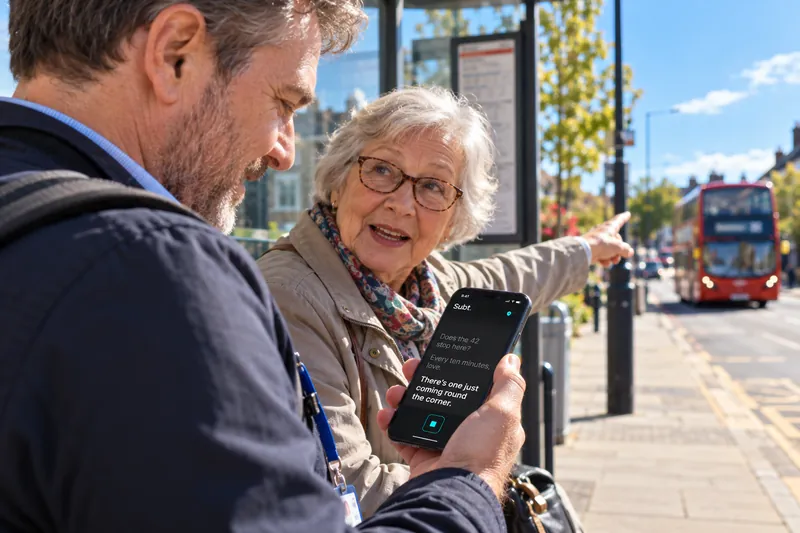
For the answers coming back through the glass, a live caption app can help. Subt is one option: open the free web app, hold your phone near the window, and what the person says appears in large text. It works best somewhere reasonably quiet, it uses your browser's speech service, and it can get times or platform numbers wrong, so check them on the board or your ticket.
7. What do I do if there's disruption?
This is when announcements matter most and are hardest to follow.
- Check the Disruptions section on National Rail or your train company's app.
- Find staff and say you're deaf. Ask them to write down what's happening and what you should do.
- If you're on board and the train stops, ask the guard or a nearby passenger. Don't wait to hear an explanation.
To report a crime or incident on a train or at a station, you can text 61016 at any time. National Rail says it goes to the British Transport Police, whose officers can meet you at a station. In an emergency, contact 999 instead. Here's how to reach 999 if you're deaf.
8. What's different in Northern Ireland?
Northern Ireland's trains are run by Translink, not the National Rail network.
- Assistance: nidirect says to contact Translink at least 24 hours before you travel. The number is 028 9066 6630. To use text relay, put 18001 in front: 18001 028 9066 6630.
- Railcard: RNID says that if you live in Northern Ireland, you won't qualify for free or discounted rail travel because you're deaf or have hearing loss, though other criteria, such as age, may apply. Translink isn't on the Railcard's list of train companies.
- Ticket offices: nidirect says many ticket office windows have induction loops, and they're clearly marked.
9. How do I contact a train company if I can't use the phone?
Use text where you can: the company's online contact form, email, app or social media.
For calls, Relay UK can help. In the Relay UK app you dial 18001 followed by the number, and a relay assistant passes the conversation between text and speech. There's more in our guide to phone calls for deaf people.
Quick answers
Is Passenger Assist only for wheelchair users?
No. It's for disabled passengers who want help with their journey, and you explain the help you need. Being told about announcements, platform changes and disruption is a reasonable request.
Can my companion use my Disabled Persons Railcard without me?
No. The adult companion gets a third off only when travelling with the railcard holder for the whole journey.
How much notice does Passenger Assist need?
On National Rail in Great Britain, up to 2 hours before your journey. In Northern Ireland, nidirect advises contacting Translink at least 24 hours ahead.
Sources
- National Rail: Passenger Assist
- National Rail: Passenger Assistance app
- National Rail: Live trains
- National Rail: Text 61016
- Railcard: Disabled Persons Railcard
- Railcard: Disabled Persons Railcard eligibility
- Railcard: Disabled Persons Railcard terms and conditions
- RNID: Discounted travel
- Office of Rail and Road: Passengers with disabilities
- GOV.UK: Disability quick start guide for service providers
- nidirect: Bus and train travel with a disability
- Relay UK: Use Relay UK with the app