1. How do I get the attention of someone who's hard of hearing?
Get their attention before you start talking.
Say their name. Give a small wave. Move into their line of sight.
Starting a sentence while walking away or calling from another room can mean the first few words disappear completely.
2. Should I face someone who's hard of hearing when I speak?
Yes. Face them.
Many people use a mixture of hearing, facial expression, context and lipreading to follow a conversation. Seeing your face gives them more information to work with.
Try not to talk while turning away, looking down at your phone or covering your mouth.
3. Does good lighting help someone with hearing loss?
It can help a lot.
Face them. Light on you, not behind you.
A bright window behind your head can leave your face in shadow, making lipreading and facial expressions harder to see. At home, changing seats or switching on a lamp may be enough.
4. Should I speak louder to someone who's hard of hearing?
Usually, no.
Speak clearly, at a natural volume and pace. Shouting can distort speech and may be uncomfortable, particularly for someone wearing hearing aids.
No exaggerated mouth movements either. Clear and natural is better.
5. Should I repeat myself if they don't hear me?
Try once. Then say it differently.
Repeating exactly the same words can leave someone stuck on exactly the same sounds. A different word or shorter sentence may provide the missing context.
Instead of repeating "Are you going to Sarah's on Thursday?" several times, try: "Sarah's house. Are you going this Thursday?"
6. How can I make group conversations easier to follow?
One person at a time.
Around a dinner table or in the pub, overlapping voices make it difficult to work out who is speaking, let alone what they're saying. Give people a chance to finish before jumping in.
If the subject suddenly changes, make that clear too. "We're talking about Saturday now" can save someone having to piece the conversation together halfway through.
7. How can I reduce background noise for someone with hearing loss?
Turn the television down. Move away from the coffee machine. Wait for the kettle to finish.
In a café or restaurant, choose the quieter end of the table if you can.
Background noise can make speech much harder to separate, even with hearing aids. Both the NHS and RNID recommend reducing noise or moving somewhere quieter where possible.
8. How do I check they've understood without being patronising?
Don't keep asking, "Did you hear me?"
Check the important detail instead. "Was Friday at two OK?" or "Just checking, we're meeting outside the station."
For something important such as an address, appointment time or medication instruction, write it down as well. (At the GP? Here's what you can ask for.)

9. Can writing things down or using captions help?
Yes. Sometimes text is simply quicker.
Write down a name or number. Type a sentence into your phone. Use live captions when spoken conversation is becoming difficult to follow.
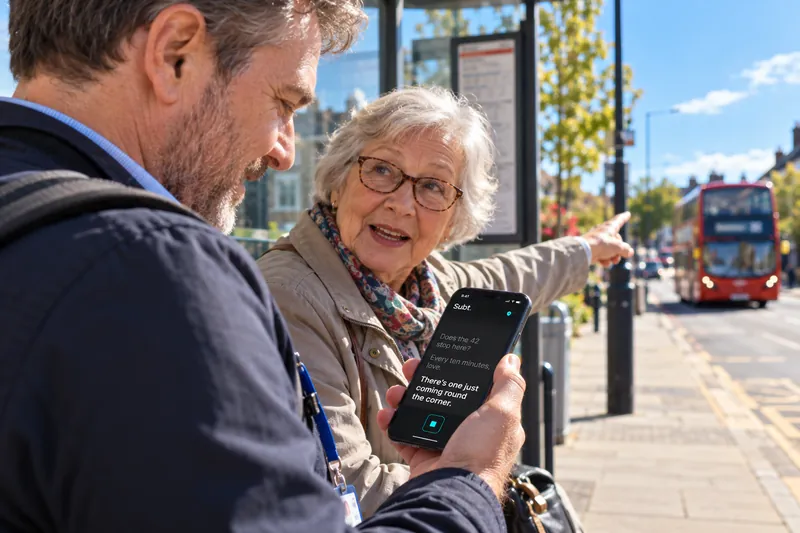
Subt is one option for face-to-face conversations: open the free web app, place your phone between you and the person speaking, and their speech appears as large text. The web version uses your browser's speech service; the coming £1.99 iPhone app processes captions on-device. Captions can help, but they aren't a replacement for someone's preferred way of communicating.
10. How patient should I be if someone keeps asking me to repeat myself?
Give them time.
Someone may be listening, watching your face, filling in missed words and following the conversation at the same time. That takes effort.
Asked again? Say it again. Or rephrase it.
Avoid "never mind". It can turn a missed sentence into being left out altogether.
11. How do I make sure someone with hearing loss isn't left out?
Keep them in the conversation.
If everyone laughs at something they missed, explain what was said. If the topic changes, bring them with you.
And speak to the person directly. Don't automatically direct the conversation through their partner, relative or interpreter.
12. What's the best way to ask someone how they want to communicate?
Keep it simple: "What works best for you?"
Some people want you to face them. Some prefer captions or written text. Others use hearing aids, cochlear implants or other devices.
Some Deaf people use British Sign Language as their first or preferred language and may want a BSL interpreter in situations where one is needed.
No single method works for everybody. Ask rather than assume.
Should I speak slowly to someone who's hard of hearing?
Speak clearly and at a natural or slightly slower pace.
Don't stretch every word. Very slow or exaggerated speech can make normal speech patterns harder to recognise.
Is it rude to ask someone about their hearing?
It is usually better to ask what helps than to guess.
Keep it practical. "What's the easiest way for us to communicate?" puts the choice with them.
Do all deaf people lipread?
No.
Some deaf and hard-of-hearing people use lipreading as part of communication; others don't. How useful it is can also change with lighting, context and who is speaking.
Do all Deaf people use BSL?
No.
Some Deaf people use British Sign Language as their first or preferred language. Others use spoken English, lipreading, captions, hearing technology or a mixture.