This article covers NHS services in England. Scotland, Wales and Northern Ireland have their own health systems and arrangements.
1. What are my rights at a deaf GP appointment?
In England, the NHS Accessible Information Standard covers people with information or communication needs related to a disability, impairment or sensory loss.
That includes Deaf people and people with hearing loss.
GP practices must have a process to identify, record, flag, share and meet those needs.
So don't just ask for "hearing support". Be specific.
"Contact me in writing, not by phone." "I need a BSL interpreter." "Please face me when you speak."
Ask for that need to be recorded clearly on your patient record so staff can see it and act on it.
2. Can I ask my GP to contact me without phoning?
Yes.
The Accessible Information Standard requires NHS services to provide a contact method that is accessible to you where your disability or sensory loss creates a communication need.
RNID suggests alternatives such as email, text messages and Relay UK. Your practice may also offer online appointment requests or messaging through its own systems.
Ask what is available, then ask the practice to record the method you can actually use.
If phone calls aren't accessible, "just ring us" is not a useful solution.
3. Can I ask for a BSL interpreter at my GP appointment?
Yes. If you need a British Sign Language interpreter to communicate effectively, tell the practice when you book.
The Accessible Information Standard specifically covers communication support, including qualified BSL interpreters.
Ask as early as you can. That gives the practice time to arrange and confirm the interpreter before your appointment.
You should not be charged for a reasonable adjustment needed to access a service. GOV.UK guidance on the Equality Act 2010 says service providers cannot charge disabled people for reasonable adjustments.
And you should not have to use a partner, child or friend as your interpreter. (If you're family, here's how to help without taking over.) If you need professional communication support, ask for it.
4. Can I ask for a longer GP appointment if I'm deaf?
Yes.
The Accessible Information Standard says organisations should provide a longer appointment where this is needed to support effective communication or accessible information.
That might be useful if you're using a BSL interpreter, speech-to-text support, lipreading or written questions, or if you simply need more time to check that important information is clear.
Ask when booking.
"I need a longer appointment because of my communication needs."
More time. Less rushing.
5. How do I stop missing my name in the waiting room?
Tell reception when you arrive.
If you cannot reliably hear your name being called, ask staff to use another way to get your attention. They might come over to you, use a visual display if one is available, or agree another method with you.
Keep it simple.
"I'm deaf. Please come and get me rather than calling my name."
Don't leave it to chance.

6. Can I ask the doctor to write things down?
Yes.
Ask for important information in writing if that makes it easier to understand or refer back to later.
Medication changes. Dosages. Appointment dates. Referral details. What happens next.
Write the important bit.
The Accessible Information Standard requires NHS services to provide information in a way that meets a person's recorded communication needs.
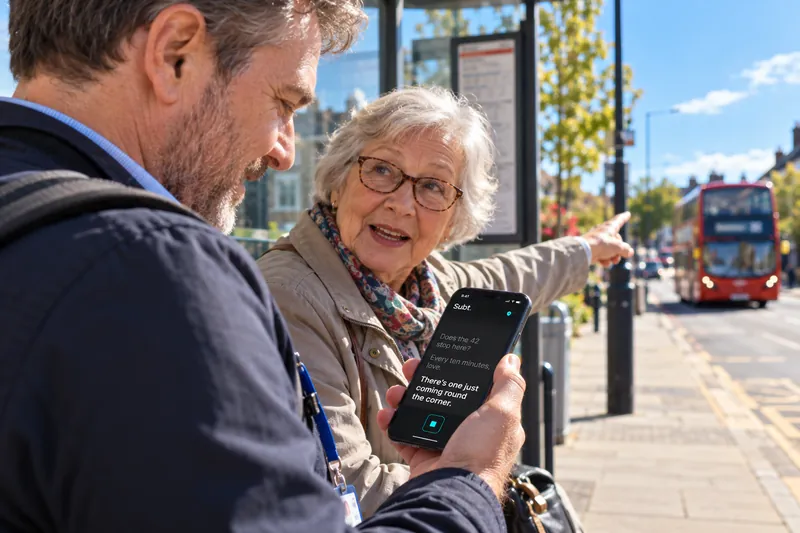
For quick conversations at reception or with a pharmacist, a live caption app such as Subt can be useful as a back-up: the free web app puts spoken words into large text using your browser's speech service, while the coming £1.99 iPhone app processes captions on-device. It can help with a short exchange, but it is not a replacement for a BSL interpreter or other professional communication support when that is what you need.
7. How can I use NHS 111 if I'm Deaf or hard of hearing?
You do not have to rely on an ordinary voice call.
For BSL, NHS 111 has a British Sign Language interpreter service.
For text relay, use Relay UK and call 18001 111 (NHS England: accessing NHS 111).
NHS 111 is also available online at 111.nhs.uk for people who can use the online service.
If it is a life-threatening emergency, use 999 rather than 111.
8. Can I use Relay UK to phone my GP?
Yes.
Relay UK can help if hearing or speech makes an ordinary phone conversation difficult. A relay assistant passes the conversation between text and speech.
RNID includes Relay UK among the options that can make contact with a GP practice more accessible.
But if another contact method works better for you, such as text, email or an online system, tell the practice that instead.
The aim is access, not making one particular method fit everybody.
9. What do I do if my GP ignores my communication needs?
Start with the practice.
Explain what happened, what your recorded need is and what needs to change. If reception or clinical staff cannot resolve it, ask to speak or correspond with the practice manager.
Be specific.
"I asked not to be contacted by phone, but I'm still being called." "I need a BSL interpreter and one wasn't arranged." "My communication needs aren't being followed."
If the issue still isn't resolved, you can make a formal complaint.
In England, you can usually complain either to the GP practice as the provider or to the local Integrated Care Board responsible for the service. NHS England says you cannot pursue the same complaint through both routes at the same time.
Quick answers
Do I have to bring someone with me to help me communicate?
No.
You can bring someone if you want to, but you should not have to rely on a friend or relative to make an NHS appointment accessible.
If you need professional communication support such as a BSL interpreter, tell the practice.
Can a GP refuse to provide a BSL interpreter?
NHS services have duties to meet disabled people's communication needs, and the Accessible Information Standard specifically includes qualified BSL interpreters as communication support.
What support is appropriate depends on your needs and the situation. If you need an interpreter to communicate effectively and suitable support is not arranged, raise it with the practice manager and use the complaints process if necessary.
Does the Accessible Information Standard apply to GP practices?
Yes.
The NHS Accessible Information Standard applies to organisations providing NHS and adult social care services in England, including GP practices.
It covers information and communication needs related to disability, impairment or sensory loss.
Sources
- NHS England: Accessible Information Standard
- NHS England: Accessible Information Standard requirements (DAPB1605)
- NHS England: Accessible Information Standard implementation guidance
- NHS England: Accessing NHS 111
- RNID: Access to health and social care
- RNID: Making your GP surgery accessible
- NHS England: Feedback and complaints
- GOV.UK: Disability quick start guide for service providers