1. Why is lipreading so tiring?
Because your brain is doing several jobs at once.
You're watching lips, faces and gestures. You're listening with whatever hearing you have. You're guessing the words you missed from context, and keeping up with the next sentence while you do it.
Hearing Dogs for Deaf People puts it simply: lipreading requires deep concentration, and you'll need to give yourself frequent breaks, especially at first.
Part of the problem is that many sounds look alike. RNID's example: it's easy to mistake "biscuits" for "big kiss". The National Deaf Children's Society says only a small percentage of speech can be lipread, so you're constantly filling in the rest.
The deaf communication charity Signature calls this concentration fatigue: using more of your mental resources to lipread, listen and follow conversation.
2. What does lip-reading fatigue feel like?
It varies, but you might notice:
- feeling worn out after a conversation that others found relaxing
- feeling tired or stressed from concentrating while listening (the NHS lists this as a sign of hearing loss)
- headaches at the end of a long session, as one deaf writer describes for Signature
- losing the thread more as the day goes on
- nodding along rather than asking again
That last one is worth watching. When you're tired, it's tempting to give up and smile. You then miss more, which makes the next conversation harder.
3. How do I plan breaks without missing out?
Plan them in advance. Don't wait until you're running on empty.
Writing for Signature, profoundly deaf advocate Louise Goldsmith suggests regular breaks, such as a quick walk, making a drink or stepping outside for some fresh air.
A long family lunch, a meeting or a day out? Decide beforehand when you'll step away. Ten minutes in a quiet room can make the second half of the afternoon much easier.
It helps to say it out loud, so nobody thinks you're bored or upset.
"I'm going to grab some air for ten minutes. Lipreading is hard work."
"Can we stop for a coffee? My concentration's going."
Spread the effort across the week too. If Saturday is a wedding, maybe Friday evening is quiet.
4. Where should I sit to make lipreading easier?
Set the scene before the conversation starts.
Hearing Dogs suggests:
- good light on the speaker's face
- a quiet space, ideally with soft furnishings that absorb sound
- being at the same height as the speaker
- not too far apart
RNID adds: sit or stand at the same level as the speaker, and ask them to face the light.
In practice, sit with your back to the window so daylight falls on their face, not yours. In a café, pick a corner table away from the coffee machine. In a group, sit where you can see most faces without turning your head.
Hearing Dogs notes lipreading is especially difficult in large, noisy groups and in meetings with no hearing loop. Choose your battles. A walk with one friend may give you far more conversation for far less effort than a crowded party.
5. How do I tell people what helps?
Short and specific works best. People generally want to help; they just don't know how.
RNID suggests explaining that you lipread before the conversation starts, and checking what the subject is first. Knowing the topic makes guessing much easier.
"I lipread, so it helps if you face me."
"What are we talking about? It helps me follow."
"Could you say that a different way?"
"Could you move your hand away from your mouth? I lipread."
If you don't catch something, RNID's advice is not to worry: ask them to repeat it or say it differently.
Hearing Dogs also suggests visible cues such as a lipreading badge or wristband, so people know before they speak.
For friends and family who want the longer version, share our guide on how to talk to someone hard of hearing.

6. Can captions take some of the strain?
Yes. You don't have to choose between lipreading and text. Many people use both: watch the face, glance at the words for the bit you missed.
Writing things down helps too. Names, numbers, addresses and times are hard to lipread and easy to write.
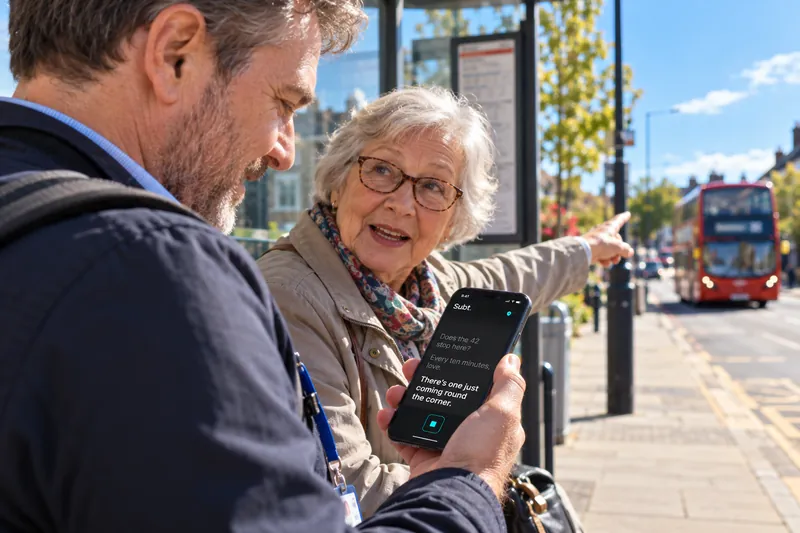
Subt is a free web app built for this kind of face-to-face moment. Put your phone on the table between you and the person speaking, and their words appear in large text. You can keep watching their face and check the screen when a word doesn't land. No account, nothing saved. The web version uses your browser's speech service (Chrome, Edge or Safari), and captions can get words wrong, especially with background noise or several people talking. It's a way to share the load, not a replacement for your hearing aids, an interpreter or a lipspeaker.
There are other options too. See our comparison of free live caption apps.
7. Would lipreading classes help?
They can. Classes teach you to lipread many different speakers, and they're also a place to share tips with people who get it.
Hearing Dogs says classes are often called "Managing Hearing Loss" or "Speech Reading" classes. Most have no more than ten people and last up to two hours with a tea break. More classes are now available online by video call.
To find one:
- search the class directory on the ATLA (Association of Teachers of Lipreading to Adults) website
- ask your audiologist or local adult education centre
- in Scotland, Hearing Dogs points to a separate directory of Scottish classes
RNID also suggests lipreadingpractice.co.uk for information and video lessons, and its Contact Centre can help you find a class.
8. Should I check my hearing aids?
If you wear them, it's worth making sure they're doing as much of the work as they can.
The NHS says you can get in touch with your audiologist at any point if you're having problems. If busy places are wearing you out, tell them exactly where and when. Ask whether anything can be adjusted.
Ask too about hearing loops. Hearing Dogs notes lipreading is much harder where there's no loop system in place.
If you don't have hearing aids and think your hearing has changed, the NHS says to see a GP.
9. What if it's getting me down?
Being tired all the time, and missing out on conversations, can wear on your mood. It's easy to start skipping things because they're exhausting.
Try not to cut yourself off completely. Shorter visits, quieter places and one-to-one time can keep you connected without draining you.
Talk to someone. Your GP is a good starting point if you're feeling low. RNID's Contact Centre can also help with practical support: phone 0808 808 0123, text 07360 268 988, use live chat on the RNID website, or call through Relay UK on 18001 then 0808 808 0123. Phone and live chat are open 8.30am to 5pm, Monday to Friday.
Quick answers
Is it normal to be exhausted after lipreading?
Yes. Hearing Dogs says lipreading requires deep concentration and frequent breaks, and the NHS lists feeling tired or stressed from concentrating while listening as a sign of hearing loss. It's a recognised effect, not a lack of effort.
Can you lipread everything someone says?
No. Many words look alike on the lips, and the National Deaf Children's Society says only a small percentage of speech can be lipread. That's why context, hearing, captions and writing things down all help.
How do I explain lip-reading fatigue to family?
Keep it simple: "Following conversation takes me a lot of concentration, so I get tired faster. Short breaks and facing me really help." Our guide to family gatherings with hearing loss has more ideas for busy occasions.