The NHS schemes in this article are for England. Scotland, Wales and Northern Ireland run their own health services, so check locally if you live there.
1. What should I say at the pharmacy counter?
Say it before they start talking. One short line at the start saves several "sorry, what was that?" moments later.
"I'm hard of hearing. Could you face me and speak clearly?"
"I lipread a bit. Could you lower your mask or move away from the screen?"
"Could you write down the important bits?"
Counters are often noisy: a till beeping, a radio, a queue. If you're struggling, say so plainly rather than nodding along.
"I'm not catching this. Can we go somewhere quieter?"
2. Can I talk to the pharmacist somewhere quieter?
Yes. Ask for the consultation room.
NHS England says that pharmacies have private consultation rooms for seeing patients, and that pharmacists can see patients for clinical services without always needing an appointment.
A smaller room usually means less background noise and a clearer view of the pharmacist's face. It also means you can ask questions without an audience.
"Could we use the consultation room? It's easier for me to hear in there."
3. Can I get my medicine instructions written down?
Yes, and for medicines it's worth asking every time.
Dosage, timing, food, alcohol, side effects to watch for: these are exactly the details that go missing in a noisy shop.
"Could you make sure the dose is on the label and write down anything else I need to know?"
Check the printed label and leaflet before you leave, while the pharmacist is still there to answer questions.
In England, the Accessible Information Standard applies to NHS services including community pharmacy. It requires services to identify, record, flag, share, meet and review people's information and communication needs, including support from a communication professional such as a BSL interpreter.
So if you use the same pharmacy regularly, ask them to record what works for you.
"Please note on my record that I'm hard of hearing and need things written down."
4. How do I check I've understood?
Say it back in your own words. Pharmacists are used to this, and it catches mistakes on both sides.
"So it's one tablet in the morning, one at night, with food. Have I got that right?"
When you're prescribed a medicine for the first time, depending on the condition, the NHS says a pharmacist may offer up to 3 appointments, in person or on the phone, to check it's working and answer your questions. If phone calls are hard, ask for those appointments in person.
"I can't do phone appointments. Can we do this face to face?"
5. Does the pharmacy have a hearing loop?
Some do. Look for the hearing loop sign at the counter: a white ear on a blue background, with a "T" in the corner.
RNID explains that to use a loop you switch your hearing aid to its telecoil programme, sometimes called the loop programme or "T" setting. If you're not sure whether your hearing aids have it, ask your audiologist.
If there is a loop, check it's switched on and working. Staff don't always know.
Under the Equality Act 2010 in England, Scotland and Wales, service providers should make reasonable adjustments, and GOV.UK guidance gives "an induction loop for customers with hearing aids" as an example of an auxiliary aid. It also says they cannot charge disabled customers for reasonable adjustments.

6. What if there's no loop and the counter's still too noisy?
Use whatever gets the words across. Ask them to write on a notepad. Type on your phone and turn it round. Or use live captions.
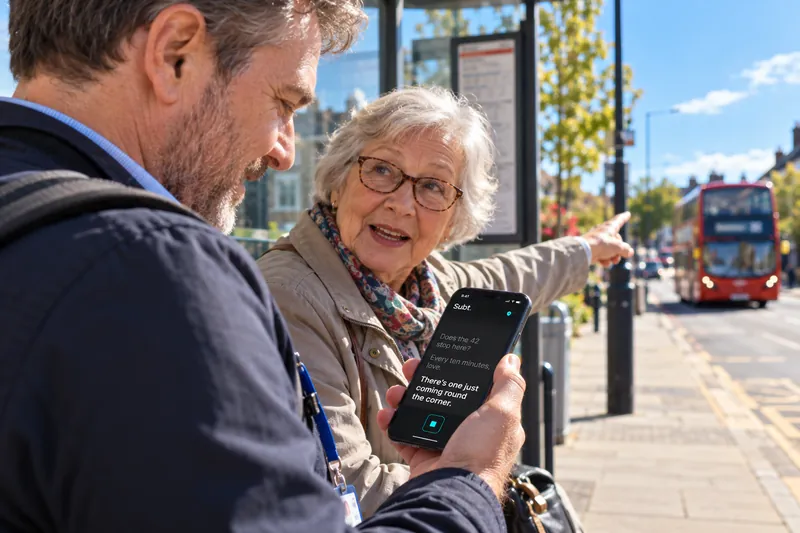
Subt is one option for a quick exchange like this: open the free web app, put your phone on the counter between you and the pharmacist, and what they say appears in large text. The web version uses your browser's speech service and nothing is saved. Captions can mishear a drug name or a number, though, so always check doses against the label rather than relying on the screen.
7. How do I order repeat prescriptions without phoning?
You don't need to ring anyone.
The NHS says you can order a repeat prescription by logging into the NHS App or the NHS website, through your GP surgery's own online service, or by contacting your GP surgery. It recommends ordering up to 5 working days before you need your medicine.
In the NHS App, go to Prescriptions, then Request a repeat prescription. Your GP surgery approves it, and you can follow its progress in the app.
The NHS also says the pharmacy may be able to let you know when your medicine is ready, or deliver it. Tell them how to reach you.
"Please text me when it's ready. I can't hear phone calls."
If your GP has set up repeat dispensing, you may be able to ask the pharmacy for your medicine directly.
8. What is Pharmacy First, and can I use it?
Pharmacy First is an NHS England service, launched on 31 January 2024, that lets community pharmacies assess and treat seven common conditions, including prescription medicine where needed, without you seeing a GP.
The conditions listed by the NHS are:
- impetigo (aged 1 and over)
- infected insect bites (aged 1 and over)
- earache (aged 1 to 17)
- sore throat (aged 5 and over)
- sinusitis (aged 12 and over)
- urinary tract infections (women aged 16 to 64)
- shingles (aged 18 and over)
You don't need a referral, and you don't always need an appointment. You can contact or walk into the pharmacy, or be referred by your GP practice, NHS 111 or an urgent care service. Not every pharmacy offers every service, so check first.
This is a proper clinical consultation, so it's exactly when to ask for the consultation room and written advice. If you need a BSL interpreter for it, say so, and ask how they can arrange one.
9. What if the pharmacy doesn't meet my needs?
Start with the pharmacist or the pharmacy manager. Be specific about what went wrong and what you need.
"I asked for the instructions in writing and didn't get them."
"I'm still being phoned when I asked for texts."
If you need to contact the pharmacy by phone, Relay UK can help. In the Relay UK app you dial 18001 followed by the number, and a relay assistant passes the conversation between text and speech.
Your GP surgery is covered by the same standard. Here's what you can ask your GP for.
Quick answers
Does the Accessible Information Standard apply to pharmacies?
Yes, in England. NHS England's requirements list community pharmacy alongside general practice, dental and optometry services. Scotland, Wales and Northern Ireland have their own arrangements.
Can I ask the pharmacy to text me instead of calling?
Yes. Ask, and ask them to note it on your record. RNID says health services should offer a range of accessible ways to contact them, such as email, text or online booking.
Should I rely on a caption app for my medicine instructions?
No. A caption app can help with a quick conversation, but it can mishear names, numbers and doses. Always check the printed label and leaflet, and ask for anything important in writing.
Sources
- NHS England: Pharmacy First
- NHS England: Accessible Information Standard requirements (DAPB1605)
- NHS: How pharmacies can help
- NHS: How to order a repeat prescription
- NHS App help: Ordering a prescription
- RNID: Hearing loops
- RNID: Access to health and social care
- GOV.UK: Disability quick start guide for service providers
- Relay UK: Use Relay UK with the app